Non-Resident Tax
Selling a Spanish Property as a UK Resident: CGT, the Euro Gain and the Credit
In brief
A UK resident selling a home in Spain pays Spanish non-resident tax at 19% of the gain, settled on Modelo 210, after the buyer withholds 3% of the price on account. The UK then charges CGT at 18% or 24% on the gain measured in pounds, converting cost and proceeds at each date's exchange rate, and credits the final Spanish tax up to the UK tax on that gain. The sale goes on Self Assessment, not the 60-day return.
If you live in the UK and sell a home in Spain, the same sale is taxed twice on paper: Spain taxes the gain first, and the UK taxes it again with a credit for the Spanish tax. Most guides stop there. What they leave out is that the two countries are not measuring the same gain. Spain measures it in euros. HMRC measures it in pounds, converting your purchase and your sale at the exchange rate of each date. This guide shows how that gap changes the bill, which Spanish tax HMRC actually credits, and where the sale goes on your UK return.
What Spain charges: 19% of the gain, with 3% held back
A seller who is not resident in Spain pays Spanish non-resident income tax (Impuesto sobre la Renta de no Residentes, IRNR) at 19% of the gain under article 25.1.f of the Non-Resident Income Tax Act (TRLIRNR, Royal Legislative Decree 5/2004). Unlike rental income, where a UK resident pays 24% on the gross rent, the 19% rate on a sale gain is the same for every non-resident, inside or outside the EU.
The gain is worked out under Spanish personal income tax rules (art. 24.4 TRLIRNR, referring to Law 35/2006):
- Acquisition value: the price you paid, plus purchase costs and taxes you paid (notary, Land Registry, transfer tax or VAT) and improvements, excluding mortgage interest (art. 35.1.b).
- Transmission value: the sale price, minus selling costs you paid (art. 35.2).
- No inflation uplift: Law 26/2014 abolished the indexation coefficients for property from 1 January 2015.
On completion the buyer withholds 3% of the agreed price and pays it to the Spanish Tax Agency on Modelo 211 within one month (art. 25.2 TRLIRNR; art. 14.3 of Royal Decree 1776/2004). That 3% is a payment on account, not your tax. Your actual tax is settled on Modelo 210, due three months after the buyer’s one-month window ends, so about four months from completion (art. 14.4 of Royal Decree 1776/2004). If 19% of the gain is less than the 3% withheld, the Modelo 210 is how you get the difference back.
One Spanish relief does not reach you: the exemption for reinvesting the proceeds of a former main home (additional provision 7 TRLIRNR) is limited to residents of the EU and the European Economic Area. Since 1 January 2021 a UK resident is neither.
What the UK charges: CGT on a gain measured in pounds
A UK resident pays Capital Gains Tax on worldwide gains, including a property in Spain. The Spain–UK tax treaty signed in London on 14 March 2013 lets Spain tax the gain because the property is there (art. 13.1), and requires the UK to give credit for the Spanish tax against UK tax on the same gain (art. 22.2.a). It does not stop the UK taxing.
For 2025–26 and 2026–27, gov.uk lists CGT rates of 18% and 24% for individuals and an annual exempt amount of £3,000. The rate depends on how much of your basic-rate band your income leaves free.
The UK gain is not the Spanish gain converted at today’s rate. HMRC’s Capital Gains Manual (CG78310) applies the Bentley v Pike decision: each amount in foreign currency “must be converted into its sterling value at the time the amount is incurred/received”. In practice:
- the purchase price and purchase costs convert at the rate on the day you paid them;
- the sale price and selling costs convert at the rate on the day of the sale.
HMRC also says it “does not prescribe what reference point should be used for the exchange rate”, but expects “a reasonable and consistent method”.
The euro–sterling mismatch, in numbers
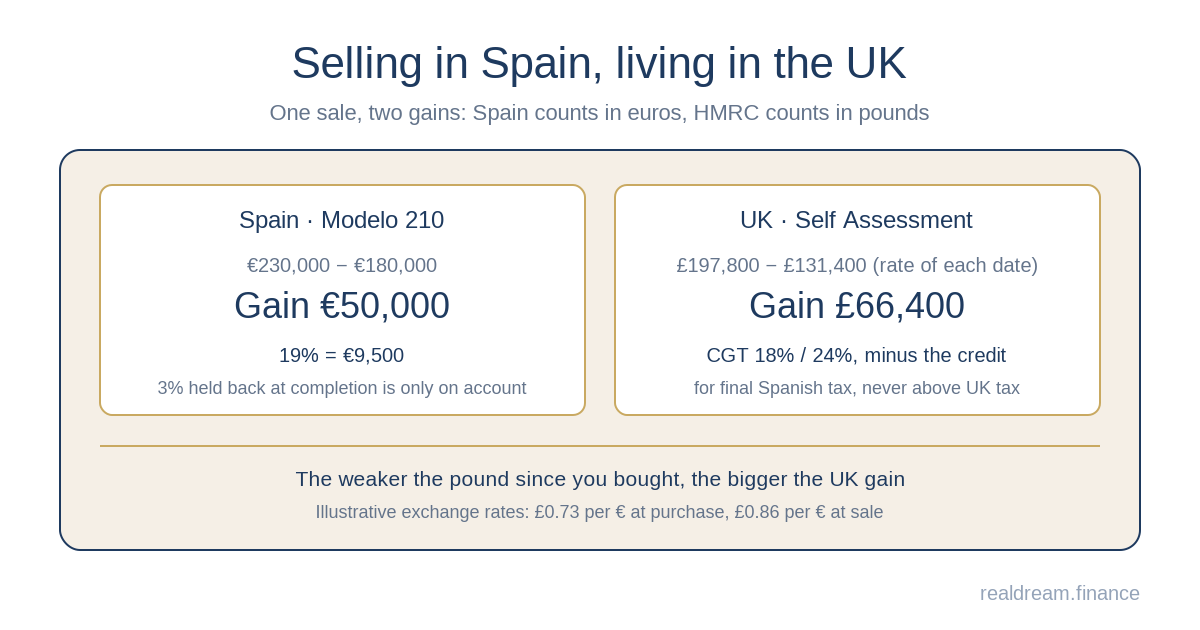
Because the two gains are measured in different currencies, a sale can show one result in Spain and a different one in the UK. The exchange rates below are illustrative, chosen to show the mechanism; they are not historical rates.
| In euros (Spain) | Rate used | In pounds (HMRC) | |
|---|---|---|---|
| Purchase, with costs | €180,000 | £0.73 per € | £131,400 |
| Sale, net of costs | €230,000 | £0.86 per € | £197,800 |
| Gain | €50,000 | £66,400 |
Spain taxes €50,000 at 19%: €9,500. Translated at the sale-date rate, about £8,170 of tax.
The UK taxes £66,400 minus the £3,000 exempt amount. For a seller paying the 24% rate on the whole gain, that is £15,216. The credit for the Spanish tax brings the UK bill down to about £7,046. The euro gain, converted at the sale-date rate, would have been £43,000: the extra £23,400 of UK gain comes entirely from the pound weakening between purchase and sale.
The mismatch also runs the other way. If the pound strengthens while you own the property, the sterling gain can be smaller than the euro gain, or even a loss. Then the UK tax on the gain is lower than the Spanish tax, and the excess Spanish tax is simply lost: HMRC’s HS263 helpsheet says it “cannot be credited against UK tax on any other capital gain”. A zero gain in euros can also become a taxable gain in pounds, with no Spanish tax to credit at all.
This is where most sellers find the sale more complicated than they expected. If you want your figures checked before you sign, the non-resident tax page sets out what our service covers and its price.
The credit is for Spanish tax due, not the 3% withheld
HMRC credits the Spanish tax you are finally liable for, not the 3% the buyer held back. HS263 sets the credit at “the lower of” the foreign tax paid, or allowed by the treaty, and the UK tax on the same gain.
The 3% retention is a payment on account that Spain refunds when it exceeds 19% of the gain. Section 33 of the Taxation (International and Other Provisions) Act 2010 limits the credit to what would be allowed had “all reasonable steps been taken”, including claiming the reliefs available abroad. In practice:
- File the Modelo 210 before you claim the credit. It fixes the Spanish tax that HMRC can credit.
- Claim the overpaid 3% back from Spain. HS263’s own Spanish example says the excess “is not available for credit” and that the taxpayer “may be able to recover this amount from the Spanish Tax authorities”.
- Keep the paper trail: the escritura (deed), the buyer’s Modelo 211 and your Modelo 210 with proof of payment.
Where the sale goes on your UK return
A Spanish property does not use the 60-day return. The gov.uk rule to “report and pay any Capital Gains Tax due on UK residential property within 60 days” applies to UK property; a gain on a home abroad is reported for the tax year of the sale.
The route is Self Assessment: the gain goes on the capital gains pages (SA108) and the Spanish tax credit is claimed on the foreign pages (SA106). Gov.uk’s real-time Capital Gains Tax service cannot report foreign tax credit relief for overseas property, so it does not fit this sale. The return for a sale in the 2026–27 tax year is due by 31 January 2028 if you file online.
Does Private Residence Relief help?
Only if the Spanish home qualified as your residence, and for a home abroad that has an extra test. Since 6 April 2015, a residence in a country where you are not tax resident counts for Private Residence Relief only in tax years that meet a minimum day count of 90 days spent in it (HMRC Capital Gains Manual CG64582). A UK resident is usually not resident in Spain, so the test applies to most holiday homes. A year that fails it is treated as a year the property was not your residence (CG64577).
Where relief does apply, it reduces the UK gain and therefore the UK tax. It does not reduce the Spanish tax: Spain’s main-home reinvestment exemption is not available to a UK resident. A lower UK bill also means a lower ceiling for the credit.
The timeline from completion
- Completion: the buyer withholds 3% of the price; the buyer often also withholds the Spanish municipal land value tax (plusvalía municipal), for which the law makes the buyer liable when the seller is non-resident.
- Within one month: the buyer pays the 3% on Modelo 211 and gives you a copy.
- Within about four months: you file Modelo 210, paying the balance or claiming the refund.
- By 31 January after the tax year ends: you report the sterling gain on SA108 and claim the credit for the final Spanish tax on SA106.
Sources
- BOE — Royal Legislative Decree 5/2004, Non-Resident Income Tax Act (TRLIRNR), arts. 24.4, 25.1.f and 25.2, additional provision 7
- BOE — Royal Decree 1776/2004, Non-Resident Income Tax Regulation (art. 14: 3% withholding and Modelo 210 deadline)
- BOE — Order EHA/3316/2010, Modelos 210 and 211 (art. 5.a)
- BOE — Law 35/2006 on personal income tax (art. 35: acquisition and transmission value)
- Agencia Tributaria — Capital gains from the transfer of property by non-residents
- BOE — Spain–UK double taxation convention, London 14 March 2013 (arts. 13 and 22)
- HMRC — Capital Gains Manual CG78310: foreign currency, assets acquired or sold for currency
- HMRC — Relief for Foreign Tax Paid (HS263) 2026
- legislation.gov.uk — Taxation (International and Other Provisions) Act 2010, section 33
- gov.uk — Capital Gains Tax rates and allowances
- gov.uk — Report and pay Capital Gains Tax: property in the UK sold on or after 6 April 2020
- gov.uk — Report and pay Capital Gains Tax: other capital gains
- HMRC — Capital Gains Manual CG64582: residences outside the UK, 90-day count
Frequently asked questions
Does the UK credit the 3% the buyer withheld in Spain?
No. The 3% is a payment on account. HMRC credits the Spanish tax you are finally liable for, which is 19% of the gain settled on Modelo 210, capped at the UK tax on the same gain. Any overpaid 3% has to be reclaimed from Spain through the Modelo 210.
Do I need to file a 60-day Capital Gains Tax return for a house in Spain?
No. The 60-day report and payment rule applies to UK residential property. A gain on a property in Spain is reported on your Self Assessment return for the tax year of the sale, with the capital gains pages and the foreign pages for the Spanish tax credit.
Which exchange rate do I use to work out the gain in pounds?
Convert the purchase price and costs at the rate on the day you paid them, and the sale proceeds at the rate on the day of the sale (HMRC Capital Gains Manual CG78310). HMRC does not prescribe a specific rate source, but expects a reasonable and consistent method.
Is a UK resident charged 24% in Spain on the sale, as on rental income?
No. The 24% rate applies to rental income of non-EU residents. Gains from selling property are taxed at 19% for every non-resident under article 25.1.f of the Spanish Non-Resident Income Tax Act, whether they live in the EU or not.
What happens if the Spanish tax is higher than the UK tax on the gain?
The credit stops at the UK tax on that gain, so you pay nothing more in the UK, but the extra Spanish tax is lost. HMRC's HS263 helpsheet says the excess cannot be credited against UK tax on any other capital gain.
Roberta
Credit intermediary registered with the Banco de España (ICI)
Want us to take care of it?
The non-resident tax page explains how the sale of your Spanish property is taxed, what the service covers and its full price.