
Mortgages & Banks
Spanish Banks Can't See Your Credit Score: What They Check Instead
In brief
No. Spain has no FICO-style score, and a UK or US score carries no weight in a Spanish file. By law (Ley 5/2019, art. 12), the lender must check the Banco de España's CIRBE register and at least one private credit file — both hold only Spanish debts, so for a first-time non-resident they come back empty. Empty is not a good score: it's no information, and the bank replaces it with documents it can verify independently.
A Spanish bank asking for your credit report is not going to read the number on the front page. Spain has no FICO-style score, the Banco de España’s credit register only holds loans granted by lenders operating in Spain, and a UK or US score has no legal route into a Spanish mortgage file. What replaces it is set out in Spanish law rather than in bank marketing: two registers the lender is obliged to consult, a list of factors it has to weigh, and a burden of proof that — for a non-resident buying for the first time — lands almost entirely on your own documents.
Why your home credit score doesn’t travel to Spain
A foreign credit score doesn’t reach a Spanish lender because none of the systems a Spanish bank consults is built to hold it.
The Banco de España’s register, the CIRBE (Central de Información de Riesgos), is fed by a closed list of “declaring entities” set out in article 60.1 of Ley 44/2002: Spanish credit institutions, Spanish branches of foreign ones, credit institutions operating in Spain under the freedom to provide services, specialist lenders and mortgage lenders, among others. A bank in London, Chicago or Stockholm lending to you at home is not on that list, so nothing it knows about you ever enters the CIRBE.
The law also limits what can flow across borders. Under article 63.2 of Ley 44/2002, the Banco de España may exchange CIRBE data, on a reciprocal basis, with equivalent public registers in other EU member states. For registers outside the EU, the same article restricts any exchange to companies and to the business risks of sole traders. Data on a private individual from the UK, the US, Switzerland or Norway is excluded by the text itself.
Finally, the private default files work differently from a scoring bureau. Article 20.3 of Ley Orgánica 3/2018 (the Spanish data protection act, LOPDGDD) says the presumption that sharing default data is lawful does not cover combining it with other information to profile the debtor, “in particular through credit scoring techniques”. The Spanish systems a bank consults are lists of debts and defaults, not a score.
What a Spanish lender is legally obliged to check
Every Spanish mortgage lender has to consult two sources before granting a loan, and both are Spanish.
Article 12.1 of Ley 5/2019 (the mortgage credit law, LCCI) requires the lender to check the applicant’s credit history in the CIRBE and in at least one private credit information system, under the conditions of data protection law. The same paragraph obliges the lender to tell you, “clearly and directly” at the pre-contractual stage, which information and “independently verifiable” evidence you must provide, and by when.
Access to the CIRBE is not open-ended. Under article 61.2 of Ley 44/2002, a lender — and, since 2019, a registered real estate credit intermediary — may request a report on you only in three cases: you already owe it money, you have applied to it for a loan, or you appear as payer or guarantor on a credit document it has been asked to acquire. A lender consulting the register because of your application has to tell you so in writing.
Three records, three different rules
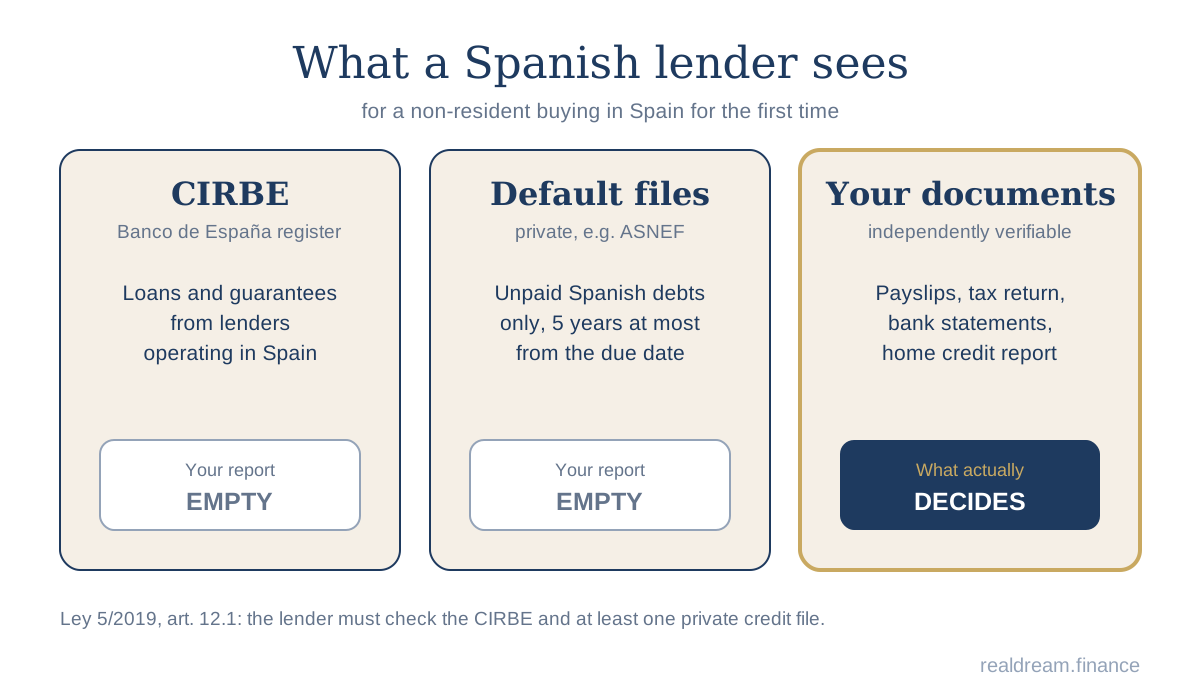
The confusion in most explanations comes from treating the CIRBE, the private default files and your home-country report as the same thing. They answer different questions:
| Record | Who runs it | What it holds | How far back | When a lender can see it |
|---|---|---|---|---|
| CIRBE | Banco de España (public) | Loans and guarantees from lenders operating in Spain; reports to lenders cover borrowers with a cumulative exposure of €1,000 or more, without naming the lending banks | Reports on individuals include only declarations from the last 5 years; the register keeps data for 10 | When you have applied to that lender for a loan |
| Private default files (e.g. ASNEF, BADEXCUG) | Private companies | Unpaid debts only — certain, due and enforceable | While the debt is unpaid, 5 years maximum from its due date | When you hold a contract with it or have applied for financing |
| Your home-country report | A bureau in your country | Whatever your country records | Your country’s rules | Only if you hand it over |
The legal bases for the first two rows: articles 61.3, 61.4 and 64 of Ley 44/2002, article 4.1 of Orden ECO/697/2004 as re-worded by Orden ECM/531/2026 of 27 May 2026, and article 20.1 of the LOPDGDD. The third row has no Spanish legal status at all: it is a document, like a payslip.
Why an empty file is not a clean slate
An empty CIRBE report means the Banco de España has no information about you — not that it has good information. Several guides describe the empty file as “neutral” or even “positive”. The mechanism the law sets up points the other way: the report was supposed to confirm your existing debts, and it can’t.
Article 11.1 of Ley 5/2019 requires the lender to assess your solvency “in depth”, taking into account your employment, current and expected income, assets, savings, fixed expenses and “the commitments already assumed”. For a resident, the CIRBE fills in most of that last item automatically. For a first-time non-resident, the lender has to rebuild it from paper — and article 12.3 is explicit about what happens if the information or verification is missing: the loan cannot be granted.
So an empty file doesn’t count against you, but it doesn’t count for you either. It moves the whole burden of proof onto documents the bank can check without relying on your word.
What replaces the score
The lender replaces the missing register data with evidence it can verify independently. The exact list varies by bank and by profile, but the documents doing the work usually fall into four groups:
- Income: recent payslips and employment contract, or tax returns and company accounts if you’re self-employed.
- Tax residency: your latest income tax return from the country where you live, which also cross-checks the declared income.
- Bank statements: several months of them, read for the regular outgoing payments a CIRBE report would have shown — a mortgage at home, car finance, personal loans.
- Your home-country credit report: read for undeclared debt and past defaults, not for the score. A loan that appears on the report but not in your declared commitments is the kind of gap that stops a file.
Because article 12.1 obliges the lender to specify the evidence and the deadline at the pre-contractual stage, ask for the list in writing at the start. It sets the scope of what you have to produce, and it’s the reference point if the request keeps growing.
Your debts abroad count in full
The commitments a Spanish lender weighs are all of your commitments, wherever they sit. Article 11.1 speaks of “the commitments already assumed” without any geographic limit, and a lender that ignored a mortgage in Manchester or a car loan in Munich would not be assessing solvency “in depth”.
No Spanish law sets a maximum ratio between debt payments and income. The 35% or 40% figures quoted online are lenders’ internal policies, and they vary. What doesn’t vary is the arithmetic, illustrated here with round hypothetical figures:
| Monthly figure (hypothetical) | Amount | Share of €6,000 net income |
|---|---|---|
| Existing mortgage at home | €1,400 | 23.33% |
| Car finance at home | €350 | 5.83% |
| Commitments already assumed | €1,750 | 29.17% |
| Room left under a 35% internal policy | €350 | 5.83% |
In this example, a lender working to 35% would have €350 a month left for the Spanish mortgage payment — before it applies any stress test of its own.
A larger deposit does not replace this calculation. Article 11.3 of Ley 5/2019 states that for a secured loan the solvency assessment cannot rest predominantly on the collateral’s value exceeding the loan, or on the assumption that the property will rise in value. Putting down 40% instead of 30% lowers the lender’s exposure; it doesn’t change what your income can carry each month.
If you’d like an early read on how your own file is likely to look to a Spanish underwriter, the non-resident mortgage pre-assessment asks for the same core figures and takes a few minutes, free and with no commitment.
Check your Spanish files before the bank does
You can see both Spanish records before any lender does, and it costs nothing.
The Banco de España states that anyone can access their CIRBE data free of charge through its online report request form. For a buyer who has never borrowed in Spain, the result will almost certainly be empty — useful mainly to confirm there’s nothing unexpected, such as a guarantee signed years ago for a relative’s Spanish loan.
For the private default files, the right of access under the GDPR applies, and the Agencia Española de Protección de Datos (AEPD) indicates that the controller has to answer within one month. These files matter more than their name suggests: under article 20.1 of the LOPDGDD, any creditor — not only banks — can report a certain, due and enforceable debt, provided it warned you in the contract or when demanding payment, and the file must notify you within 30 days of the entry. An unpaid final bill from a Spanish phone or utility contract is enough to appear, and the entry has to be removed once the debt is paid.
If a Spanish bank says no
A refusal has to reach you in writing, with reasons. Article 11.6 of Ley 5/2019 obliges the lender to inform you “in writing and without delay”, stating the grounds and whether the decision was based on automated processing. When the refusal follows a database consultation, the lender must also give you the result, the name of the database and its controller, and remind you of your right to access and correct the data. Article 20.1.f of the LOPDGDD adds the same duty for private default files.
Two practical consequences follow. An error in the CIRBE is corrected at source: the Banco de España directs you to the bank that reported the data, with a complaint to the Banco de España as the next step. And a written, reasoned refusal is exactly the document a financing clause in a contrato de arras needs to release your deposit — a verbal “no” from a branch leaves you with nothing to show.
Sources
- BOE — Ley 5/2019, reguladora de los contratos de crédito inmobiliario (arts. 11 and 12)
- BOE — Ley 44/2002, de Medidas de Reforma del Sistema Financiero (arts. 60, 61, 63 and 64: Central de Información de Riesgos)
- BOE — Orden ECM/531/2026, de 27 de mayo, amending Orden ECO/697/2004 on the Central de Información de Riesgos
- BOE — Ley Orgánica 3/2018, de Protección de Datos Personales (art. 20: sistemas de información crediticia)
- Banco de España — Central Credit Register (CCR): what it contains and how to request your report
- AEPD — Requirements for inclusion in a credit information system ("fichero de morosos")
Frequently asked questions
Do Spanish banks use my UK or US credit score?
No. Spain has no FICO-style score, and the Banco de España's CIRBE register only receives data from lenders operating in Spain. Banks often ask for your home-country credit report, but they read it for undeclared debts and past defaults, not for the number.
Is an empty CIRBE report bad for my mortgage application?
It isn't negative, but it isn't positive either: it means the register has no information about you. The lender still has to assess your commitments under article 11 of Ley 5/2019, so it rebuilds them from your bank statements, tax returns and home-country credit report.
Does a bigger deposit make up for having no Spanish credit history?
Not on its own. Article 11.3 of Ley 5/2019 says the solvency assessment cannot rest predominantly on the property being worth more than the loan. A larger deposit lowers the lender's exposure, but your income still has to carry the monthly payment.
Can a Spanish bank see my loans in my home country?
Not through the CIRBE, which only holds debts with lenders operating in Spain. It sees them through what you provide: bank statements showing regular repayments and your home-country credit report. The law counts all commitments already assumed, without any geographic limit.
What happens if a Spanish bank refuses my mortgage because of a credit file?
Under article 11.6 of Ley 5/2019 it must tell you in writing and without delay, with reasons. If the refusal follows a database check, it must give you the result, the database's name and controller, and remind you of your right to access and correct the data.
How long does an unpaid debt stay in a Spanish default file such as ASNEF?
Only while the debt remains unpaid, and never more than five years from its due date, under article 20.1 of Ley Orgánica 3/2018. The file must notify you within 30 days of the entry, and the record has to go once the debt is paid.
Roberta
Credit intermediary registered with the Banco de España (ICI)
Want us to take care of it?
We prepare the file a Spanish underwriter actually reads when there's no CIRBE history to lean on — income, commitments abroad and the documents that prove them.