Mortgages & Banks
Spanish Mortgage on a Holiday Let: What Non-Residents Must Check
In brief
Yes. A non-resident can mortgage a Spanish home they plan to let to tourists, but the loan and the licence are two separate files. The lender assesses your solvency on your employment, income, savings and existing commitments (art. 11 Ley 5/2019); a let that has not started has no income to show. Whether the let is legal depends on the regional licence, the town hall and, since 3 April 2025, a three-fifths vote of the community of owners (arts. 7.3 and 17.12 LPH).
Most guides to buying a holiday let in Spain blend two questions into one: “will a Spanish bank lend me the money?” and “will I be allowed to let it to tourists?”. They are answered by different people, under different rules, on different calendars. The lender looks at you. The licence depends on the building, the region and the town hall. Nothing in Spanish mortgage law links the two, which means a buyer can end up with an approved loan on a flat that can never be let legally. This guide separates the two files and puts them in the order that protects your deposit.
Can a non-resident get a Spanish mortgage on a holiday let?
Yes. A non-resident can take a Spanish mortgage on a home they intend to let to tourists, and the loan is assessed as a purchase by a private individual, not as a business loan on a rental operation. Spanish banks do not run a separate “holiday let mortgage” with its own rental-cover test; what they assess is the borrower.
The licence is a separate matter. It decides whether the let is legal, not whether the loan is granted.
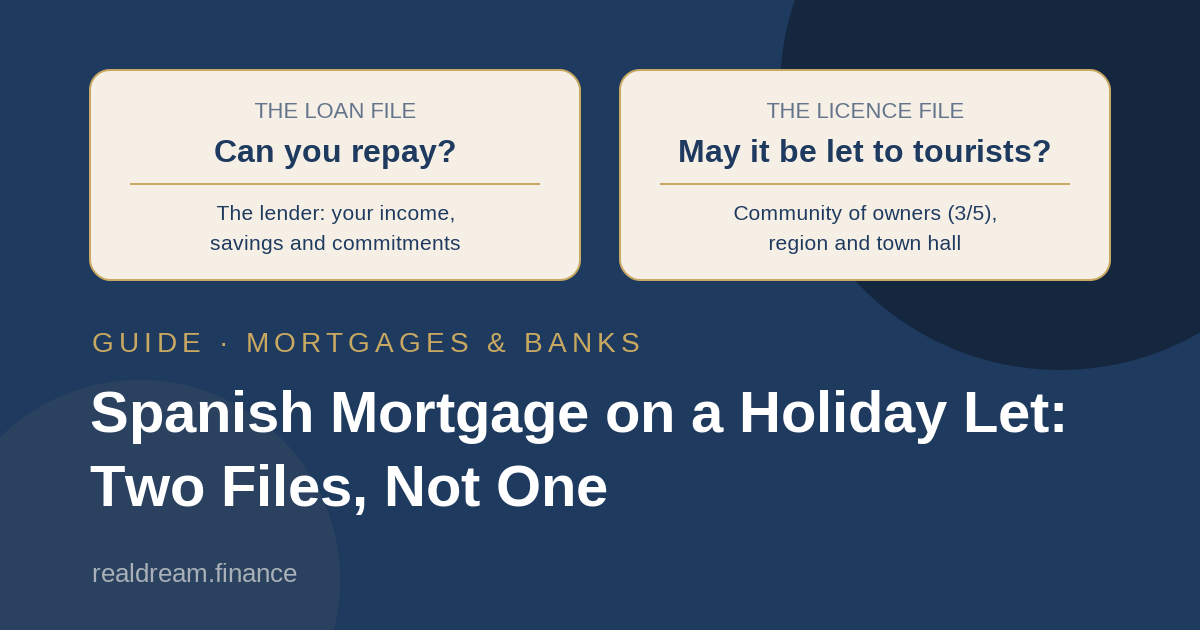
| The loan file | The licence file | |
|---|---|---|
| Question | Can you repay? | May this property be let to tourists? |
| Who decides | The lender | Community of owners, region and town hall |
| Main rule | Ley 5/2019 on real estate credit contracts, art. 11 | Ley de Propiedad Horizontal, arts. 7.3 and 17.12; regional tourism rules; local planning |
| Based on | Your income, savings and commitments | The building, its statutes and its location |
| If it fails | No loan, or a smaller one | The loan stays; the rental plan does not |
The last row is the one to remember. The two files fail independently, and only one of them is the lender’s problem.
What does a Spanish lender look at?
A Spanish lender must assess the borrower’s solvency in depth before granting the loan, and article 11.1 of Ley 5/2019 lists what counts: employment situation, present income, income foreseeable during the life of the loan, assets owned, savings, fixed expenses and commitments already taken on.
Three consequences follow for a holiday-let buyer:
- Projected rent is not present income. A let that has not started has no tax returns, no bank statements and no occupancy history. The law mentions foreseeable income, but each lender decides through its own internal procedures (art. 11.2) what it accepts as foreseeable, and those procedures are supervised by the Banco de España. Plan on qualifying with the income you can document today.
- The property does not carry the file. Under art. 11.3 the solvency assessment cannot rest predominantly on the value of the security exceeding the loan amount, or on the assumption that the property will rise in value. A flat in a strong tourist area does not compensate for an income that falls short.
- Your existing debts count in full. A mortgage at home, a car loan and maintenance payments are “commitments already taken on” and reduce what you can borrow in Spain.
| What buyers expect to count | What article 11 actually lists |
|---|---|
| The rent the listing promises | Present income |
| The agent’s occupancy forecast | Income foreseeable during the life of the loan, as the lender’s procedures define it |
| The rising value of the area | Assets owned and savings; never predominantly the security |
| “It pays for itself” | Fixed expenses and commitments already taken on |
Does the mortgage law still protect you if you buy to let?
Yes. Article 2.1.a of Ley 5/2019 applies the Act to any loan secured by a mortgage on a residential property when the borrower, guarantor or surety is a natural person. The test is who borrows and what secures the loan, not what the buyer plans to do with the property. Buying in your own name, you keep the full set of protections even if the purpose is investment.
Two of those protections matter here:
- The FEIN and the ten-day rule. The lender must hand you the Ficha Europea de Información Normalizada (FEIN, the standardised offer sheet) at least ten natural days before signing, and the FEIN is a binding offer for the lender during that period (art. 14.1). The notary will not authorise the deed unless the prior transparency record has been signed (art. 22.2).
- The loan cannot be unwound over the assessment. Under art. 11.4 an incorrect solvency assessment does not give the lender the right to terminate or modify the loan afterwards, unless the borrower knowingly hid or falsified information.
That second rule has a side nobody advertises. If the licence is refused or the community bans tourist lets after you sign, the mortgage carries on exactly as agreed. The instalments are due whether or not a single guest ever arrives.
Buying through a company changes this picture: article 2.1 requires a natural person as borrower, guarantor or surety, so a loan to a company with no individual standing behind it falls outside the Act.
How does the valuation treat a tourist licence?
The loan amount is tied to the tasación, the official valuation, not to the price you agreed. According to the Banco de España’s customer portal, the loan normally reaches up to a maximum of 80% of the appraised value, and the valuation expires six months after it is issued. Each lender then sets its own share for non-residents under its commercial policy, so the percentage you are offered is a question to put to the lender in writing, not a number to take from a guide.
The valuation standard is Orden ECO/805/2003. Its article 4 defines mortgage value as a prudent appraisal of the future marketability of the property, taking into account its durable long-term aspects, normal local market conditions, its use at the time of valuation and its alternative uses, and it excludes speculative elements.
For a buyer, the practical reading is simple: do not assume a price premium paid “because it has a licence” will be matched in the appraisal. If the tasación comes in below the agreed price, the loan shrinks with it and the gap is paid in cash. Ask the lender, before you commit, how its valuers treat a licence that can lapse or that may not transfer.
What does the licence change?
The licence changes whether the let is legal, and three independent levels can each say no.
| Level | Who decides | What the rule says |
|---|---|---|
| Building | Community of owners | Prior express approval, by three-fifths of owners who also represent three-fifths of the ownership quotas (arts. 7.3 and 17.12 LPH, in force since 3 April 2025) |
| Licence and register | Autonomous community | Regional tourism rules: requirements, duration and transferability differ by region |
| Land use | Town hall | Local planning may exclude tourist use in an area or cap it |
Three details in the building rule are routinely missed:
- The same three-fifths majority can limit, condition or ban the activity, and can set special charges or raise that flat’s share of common expenses by up to 20% (art. 17.12 LPH).
- These agreements have no retroactive effect. The article says so expressly, so a ban voted today does not cancel an activity that was already lawful.
- The second additional provision protects the owner who was already letting before 3 April 2025 under the regional tourism rules. The wording refers to that owner. Whether a buyer steps into the same position is a question to put to a Spanish lawyer in writing before signing.
On registration, check the regional register. In judgment no. 620/2026, announced on 21 May 2026, the Tribunal Supremo annulled the provisions of Real Decreto 1312/2024 that created a single national register of short-term lets, because the State lacks the power to set up a national register overlapping the regional ones. The same judgment left in place the digital single window and the platforms’ data-transmission duties. A listing that shows only a national registration number proves very little; the number that matters is the regional licence, matched to that exact property.
If you want to know whether the purchase is financeable on your income alone before you sign anything, our non-resident mortgage pre-assessment gives you that reading first.
In what order should you check the loan and the licence?
Check the licence before the contrato de arras, the deposit contract, and write both files into it as conditions. Under article 1454 of the Código Civil, a buyer who withdraws from penitential arras loses the deposit; a condition written into the contract is what turns a failed licence or a refused loan into a refund instead.
- Before any deposit. Ask for the community’s statutes and the minutes of recent meetings, a written statement from the administrator that no agreement limits or bans tourist lets, the regional licence number, and proof that the activity started before 3 April 2025 if the seller relies on it.
- Verify the licence yourself on the regional register: same address, same cadastral reference, active status.
- In the arras. Make the purchase conditional on (a) an active licence that transfers to you, or a new one obtained by a set date, (b) the absence of community agreements against the activity, with the minutes attached, and (c) mortgage approval within a realistic deadline. Each failed condition returns the deposit in full.
- Only then, the loan commitment. Request the valuation and the FEIN once the licence position is closed. The buyer pays for the valuation, and it expires after six months.
- At signing. Confirm nothing changed: no new community meeting called on tourist use, licence still active.
The exact wording of the conditions is work for a lawyer. Their content is yours to demand.
Can you afford the property without the rent?
Run the numbers twice: once with the rent, once without it. The lender does the second calculation, and it is also the one that tells you whether a refused licence would be an inconvenience or a crisis.
The rent itself is also smaller than the listing suggests once tax is applied. A landlord resident in the EU or EEA pays non-resident income tax at 19% on rent minus expenses; a landlord resident in the UK, the US or another third country pays 24% on the gross rent, with no expenses deducted (arts. 24 and 25 of the Non-Resident Income Tax Act). Mortgage interest is one of the expenses only the first group can deduct.
Common mistakes
- Treating mortgage approval as confirmation that the property can be let. The lender does not check the licence.
- Sizing the loan on the rent in the listing instead of on documented income.
- Trusting “tourist licence included” without matching the number on the regional register.
- Assuming the seller’s position passes to the buyer automatically.
- Paying the deposit before the conditions are in the arras.
- Ordering the valuation before the licence question is closed.
Checklist before you sign
- You qualify for the loan on your own documented income, without the rent.
- You have the statutes, the recent minutes and the administrator’s written statement.
- You have matched the regional licence number to the property and confirmed it is active.
- You know, in writing, whether the licence transfers or a new one is needed.
- The town hall has confirmed tourist use is allowed at that address today.
- The arras makes the purchase conditional on the licence, the community position and the loan.
- You have asked the lender how the valuation treats the licence and what share it lends to non-residents.
- You have received the FEIN at least ten natural days before the signing date.
With all eight closed, a holiday let is an investment to judge on its numbers. With one open, you are borrowing against a permission you do not yet have.
Sources
- BOE — Ley 5/2019, de 15 de marzo, reguladora de los contratos de crédito inmobiliario (arts. 2.1, 11, 14.1 and 22.2)
- BOE — Ley 49/1960, de 21 de julio, sobre propiedad horizontal (arts. 7.3 and 17.12, second additional provision)
- BOE — Ley Orgánica 1/2025, de 2 de enero (final provision amending the Ley de Propiedad Horizontal, in force from 3 April 2025)
- BOE — Orden ECO/805/2003, de 27 de marzo, on property valuation rules (art. 4: mortgage value)
- Banco de España, Portal del Cliente Bancario — La tasación no solo es un mero trámite (loan normally up to 80% of appraised value; valuation valid six months)
- Poder Judicial — El Tribunal Supremo anula el Registro Único de arrendamientos de corta duración (STS 620/2026, press note of 21 May 2026)
- BOE — Código Civil, artículo 1454 (arras)
- BOE — Real Decreto Legislativo 5/2004, texto refundido de la Ley del Impuesto sobre la Renta de no Residentes (arts. 24 and 25)
Frequently asked questions
Do Spanish banks count holiday rental income when assessing a non-resident mortgage?
Plan on no. Article 11.1 of Ley 5/2019 lists employment, present income, income foreseeable during the loan, assets, savings, fixed expenses and existing commitments. A let that has not started has no documented income, and each lender defines through its own internal procedures what it accepts as foreseeable.
Is there a buy-to-let or holiday-let mortgage for non-residents in Spain?
Spanish lenders assess the purchase as a loan to a private individual secured on a residential property, not as a business loan on a rental operation. There is no rental-cover test of the kind UK buy-to-let lenders use: the assessment under article 11 of Ley 5/2019 is about the borrower's own solvency.
Does a Spanish bank check the tourist licence before granting the mortgage?
The solvency assessment required by article 11 of Ley 5/2019 concerns the borrower, not the legality of a planned tourist let. Mortgage approval is therefore no confirmation that the property can be let. The licence, the community of owners' position and the town hall's planning rules must be checked separately, before the deposit.
What happens to my mortgage if the tourist licence is refused after I buy?
The mortgage continues as agreed. Under article 11.4 of Ley 5/2019 the lender cannot terminate or modify the loan because of the solvency assessment, and nothing in the loan depends on the licence. The instalments stay due, which is why the loan should be affordable on your income without the rent.
Does Spain's mortgage law protect me if I buy as an investment?
Yes, if you borrow in your own name. Article 2.1.a of Ley 5/2019 covers loans secured on residential property when the borrower, guarantor or surety is a natural person, whatever the purpose. You receive the FEIN at least ten natural days before signing, and the notary checks the prior transparency record.
Do I still need a registration number after the Supreme Court ruling?
Yes, the regional one. Judgment no. 620/2026 of the Tribunal Supremo annulled the single national register created by Real Decreto 1312/2024, but kept the digital single window and the platforms' data-transmission duties. Regional licences and tourism registers remain in force and are the ones to verify.
Roberta
Credit intermediary registered with the Banco de España (ICI)
Want us to take care of it?
We pre-assess whether the purchase is financeable on your own income before you commit to a deposit, and structure the file for Spanish lenders.